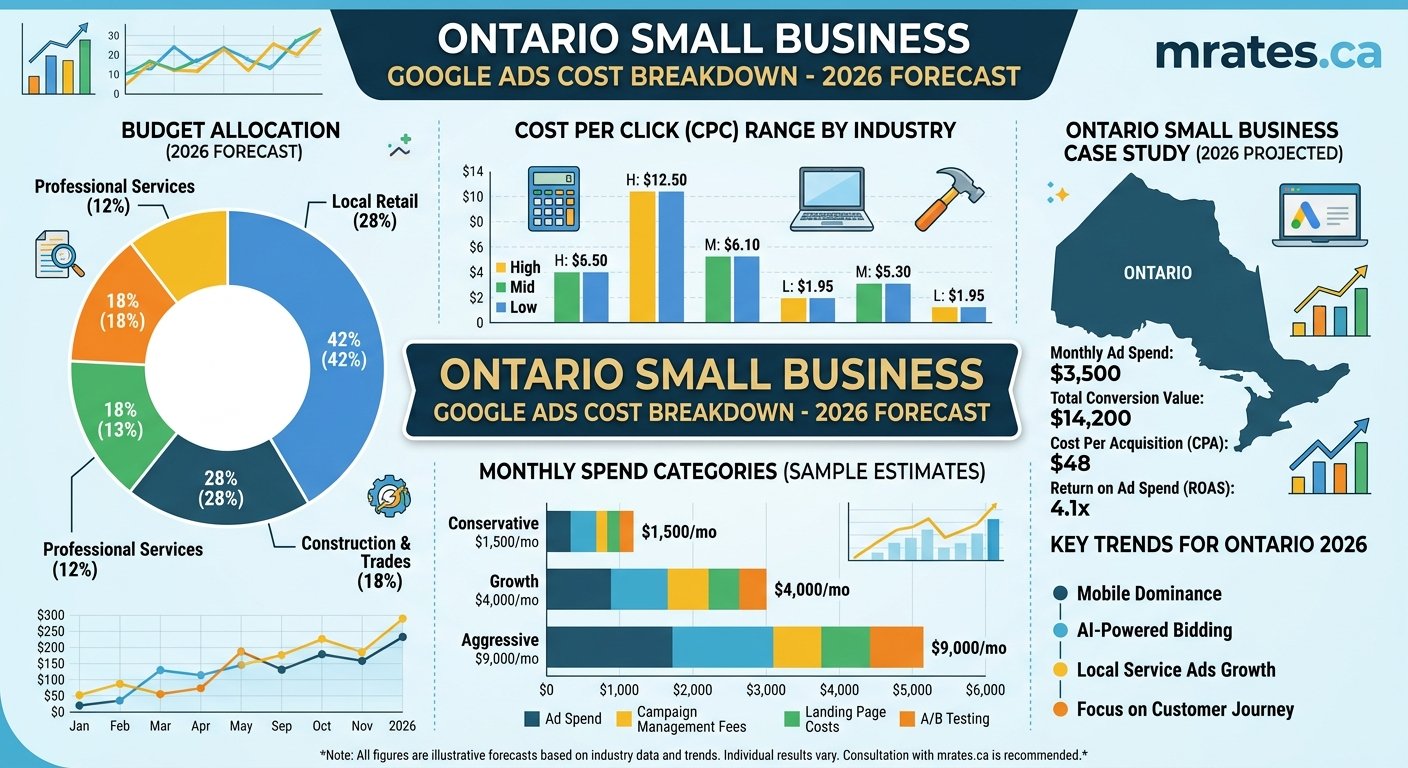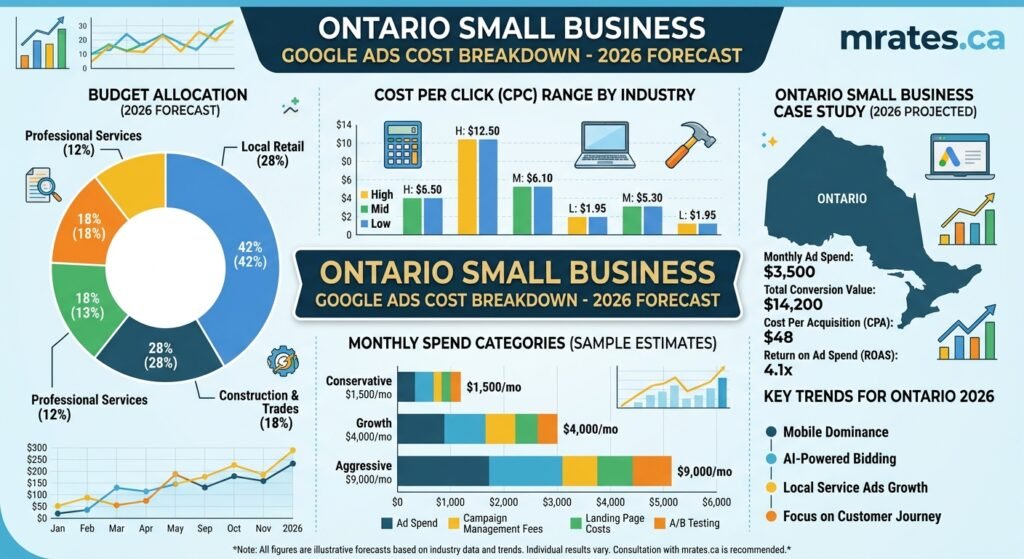
The first question almost every Ontario business owner asks about paid search is simple: what will it cost, and will it make money back? The honest answer is that Google Ads cost depends on your industry, your location and how well the account is run, but there are clear 2026 benchmarks you can plan around. This guide breaks down the real Google Ads cost numbers so you can set a budget with your eyes open.
How Google Ads pricing actually works
Google Ads runs on an auction. You bid on the search terms you want to show up for, and you pay only when someone clicks, not when your ad is shown. Two things decide your position and your price: your bid, and your Quality Score, a 1-to-10 rating of how relevant your ad and landing page are to the search. A business with a tightly focused, relevant ad can outrank a bigger competitor bidding more, simply by being more relevant. That is why Google Ads cost is as much about account quality as it is about budget size.
The 2026 benchmarks that matter
Across all industries, the average cost per click in 2026 sits around $5 to $6.30, according to WordStream’s benchmark study of tens of thousands of campaigns. Average cost per lead is about $66.69, which is the first year-over-year decrease in five years. Average conversion rates land in the 6% to 8% range for well-built campaigns.
Those are averages, and your industry moves the Google Ads cost a lot:
| Industry | Typical cost per click | Typical cost per lead |
|---|---|---|
| Home and trades services | $4 – $8 | $50 – $100 |
| Business and professional services | $5.58 | $103.54 |
| Real estate | $2 – $8 | $40 – $90 |
| Legal | $50 – $150 | $130+ |
| Finance and loans | $30 – $70 | $150+ |
Two forces are pushing the Google Ads cost per click up: more advertisers competing for the same keywords, and AI-powered bidding that chases conversions aggressively. Average CPC has risen roughly 18% since 2024. The counterweight is that targeting and automation have also improved, so a well-managed account holds its return on ad spend steady even as clicks cost more.
What should an Ontario small business budget?
For most small businesses, a sensible starting budget is $1,000 to $5,000 a month in ad spend. The key is giving Google enough daily room to learn. If your average click costs $4, a $30 to $45 daily budget lets the system gather the conversion data it needs to optimize. Starve the budget below that and the campaign never gets out of the learning phase, which pushes your effective Google Ads cost per lead up rather than down.
Think in cost per lead, not cost per click. A $10 click sounds expensive until you work out that if one in ten clicks becomes a lead, your cost per lead is $100, and if that lead is worth $2,000 to your business, the math works comfortably. The number that decides whether Google Ads is worth it for you is the value of a customer, not the price of a click.
The hidden line item: management
Ad spend is only part of the total Google Ads cost. If you hire an agency or freelancer, management typically runs $500 to $2,000 a month for a small account, or a percentage of spend. That fee is not pure overhead. The difference between an optimized account and a neglected one is usually larger than the fee itself, because a poorly set-up campaign quietly wastes budget on the wrong clicks.
Where small budgets get wasted
- Running Display or Performance Max for lead generation. For a small business chasing enquiries, a plain Search campaign almost always beats both. Display clicks are cheap but rarely convert, and Performance Max hides where your money goes.
- Using broad match keywords with no negative keywords, so you pay for searches that will never buy.
- Pointing ads at a slow or generic homepage instead of a focused landing page, which drags down conversion rate and raises your Google Ads cost per lead.
- Setting a campaign live and never returning to it. Accounts need regular review against benchmarks, or the cost per lead drifts upward unnoticed.
Is Google Ads worth it for a small business?
Here is the fair two-sided view. In favour: Google Ads puts you in front of someone at the exact moment they are searching to buy, the results are measurable to the dollar, and for service businesses the intent is high. Against: it is easy to burn a budget with no system, the clicks are not getting cheaper, and once you stop paying the traffic stops, unlike organic search. The deciding factor is whether your customer is worth enough, and your account is run well enough, for the lead math to clear. You can read how costs are calculated straight from Google Ads Help and check current figures against the WordStream benchmarks.
If you want to see what Google Ads cost would look like for your specific industry and target area in Ontario, we map that out before you spend a dollar. Learn more about our Google and Meta Ads service or request a free ad audit and we will show you the realistic numbers for your business.