[rank_math_toc]

Google Ads budget for small business is one of the first questions owners ask us, and the honest answer is that a number pulled from a blog means little without context. What matters is what a click costs in your industry, how many clicks it takes to win a customer, and how much you can spend before the math stops working. This guide gives you real 2026 figures and six rules for setting a budget that actually pays back.
It is written for Ontario service businesses, from trades and clinics to law firms and local shops, that want leads rather than vanity clicks.
What a Google Ads budget for small business really buys
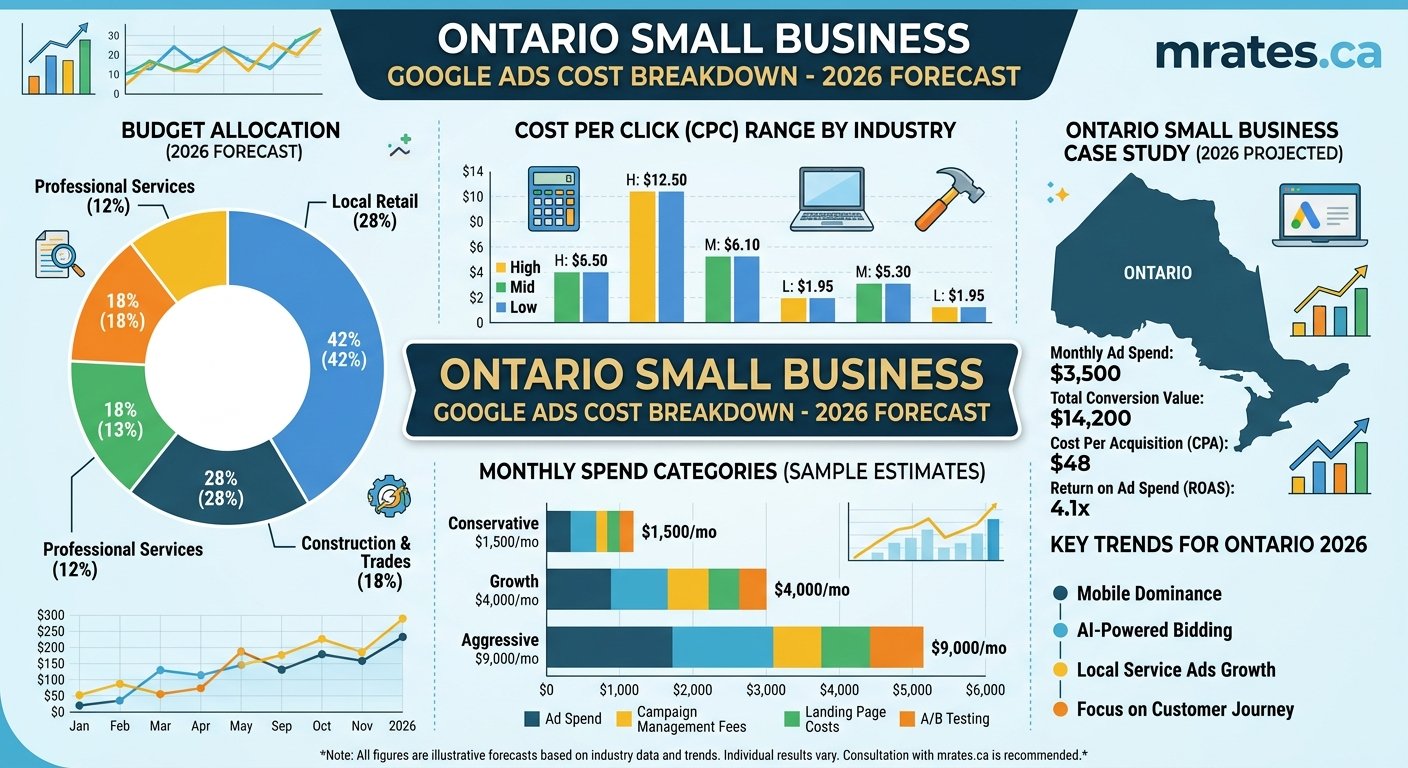
Google Ads runs on an auction. You never pay a fixed fee. You set what you are willing to pay per click, Google weighs your ad quality, and you pay only when someone clicks. Across all industries in 2026, the average search cost per click is about $5.42, according to WordStream and LocaliQ data.
That average hides huge swings. A Toronto study of 19 Canadian industries found insurance keywords averaging $33.81 per click and legal services $26.39, while event and party services sat near $3.33 and beauty near $3.42. Costs also rose about 12% year over year, the steepest jump since 2021, as advertisers shifted budget into paid search to offset clicks lost to Google’s AI Overviews. You can check your own vertical against the public search advertising benchmarks.
How much should an Ontario SMB spend?
Micro-businesses often start around $500 to $1,500 a month. A typical small business runs $1,500 to $5,000, and larger local firms push higher. There is no universal right number, but there is a way to work yours out.
Start from the bottom line, not the top. Estimate what a new customer is worth to you, and how many clicks it takes to get one. If your cost per click is $4 and one in twenty clicks becomes a customer, each customer costs about $80 in ad spend. If that customer is worth $600 to you, the channel works, and you can decide how many customers a month you want to buy. That target sets your budget.
The 70-20-10 rule
A budget that never changes stops improving. A simple split keeps it healthy: put about 70% toward proven campaigns that already convert, 20% toward testing new keywords and audiences, and 10% toward genuine experiments. The proven core pays the bills while the rest finds your next win.
Google Ads budget for small business: 6 smart rules to stretch it
These are the rules we apply to Ontario accounts every week.
- Start with high-intent, local keywords. Terms that include “near me” or a city name attract people ready to buy, and they usually cost less than broad category terms. A plumber bidding on “emergency plumber Mississauga” spends better than one bidding on “plumbing”.
- Tighten your geography. If you serve the GTA, target Mississauga, Toronto, Brampton and Oakville, not all of Ontario. Every click you pay for outside your service area is wasted money.
- Use phrase and exact match, and build a negative keyword list. Broad match with no negatives is the fastest way to burn a small budget on searches that will never convert.
- Raise your Quality Score. Google rewards a relevant ad pointed at a relevant landing page with lower costs. Two advertisers bidding the same amount can pay very different prices, and a strong Quality Score can cut your cost per click roughly in half.
- Track conversions, not clicks. Set up call and form tracking so you know which keywords produce leads. Without it, you are optimizing blind and paying for traffic you cannot measure.
- Do not spread the budget too thin. A few dollars a day across many keywords rarely gathers enough data to convert. Concentrate spend on a tight, proven set until it works, then expand.
Common budget mistakes
The pattern we see most often is a small budget stretched across broad match keywords with no negatives, sending clicks to a homepage instead of a focused landing page. That setup can spend a month’s budget in days with nothing to show for it.
Running Performance Max before you have any conversion data is another trap. It needs signals to optimize against, and without them it often chases cheap, low-value clicks. Build that data with search first.
Budget beyond the ad spend
One cost owners forget is management time. A Google Ads budget for small business is not only the money that reaches Google, it is the hours spent building, watching and refining the account. Left alone, campaigns drift: costs creep up, low-value search terms slip in, and results fade.
If you manage it yourself, set aside a few hours a week for the first month, then a couple of hours weekly to maintain it. If you hire it out, expect a management fee on top of ad spend, and make sure the arrangement is tied to leads and conversions rather than clicks.
Either way, give a new campaign at least a few weeks before you judge it. Google’s system needs data to optimize, and pulling the plug in week one throws away the learning you already paid for.
Google Ads budget for small business: common questions
How much is a good Google Ads budget for small business?
Most Canadian small businesses run a Google Ads budget for small business of about $1,500 to $5,000 a month, while micro-businesses start near $500 to $1,500. Work backward from what a customer is worth to set yours.
Is a small Google Ads budget for small business worth it?
Yes, if it is focused. A tight Google Ads budget for small business aimed at high-intent local keywords in a small area can beat a larger budget spread thin across broad terms.
What raises the cost of a Google Ads budget for small business?
Competition, broad match without negatives, and a low Quality Score all push costs up. Improving ad relevance and the landing page can cut your Google Ads budget for small business cost per click roughly in half.
The bottom line
A Google Ads budget for small business is not about spending more, it is about spending where the math works. Know your cost per click, know what a customer is worth, target tightly, and measure leads instead of clicks. Do that, and even a modest budget can carry its weight.
Want a second set of eyes on your account? Webtech Analyst offers a free ad audit and a 30-minute strategy call. See how we run local campaigns on the Google and Meta Ads page, or start on the Webtech Analyst homepage. You can also read Google’s own guidance inside Google Ads.